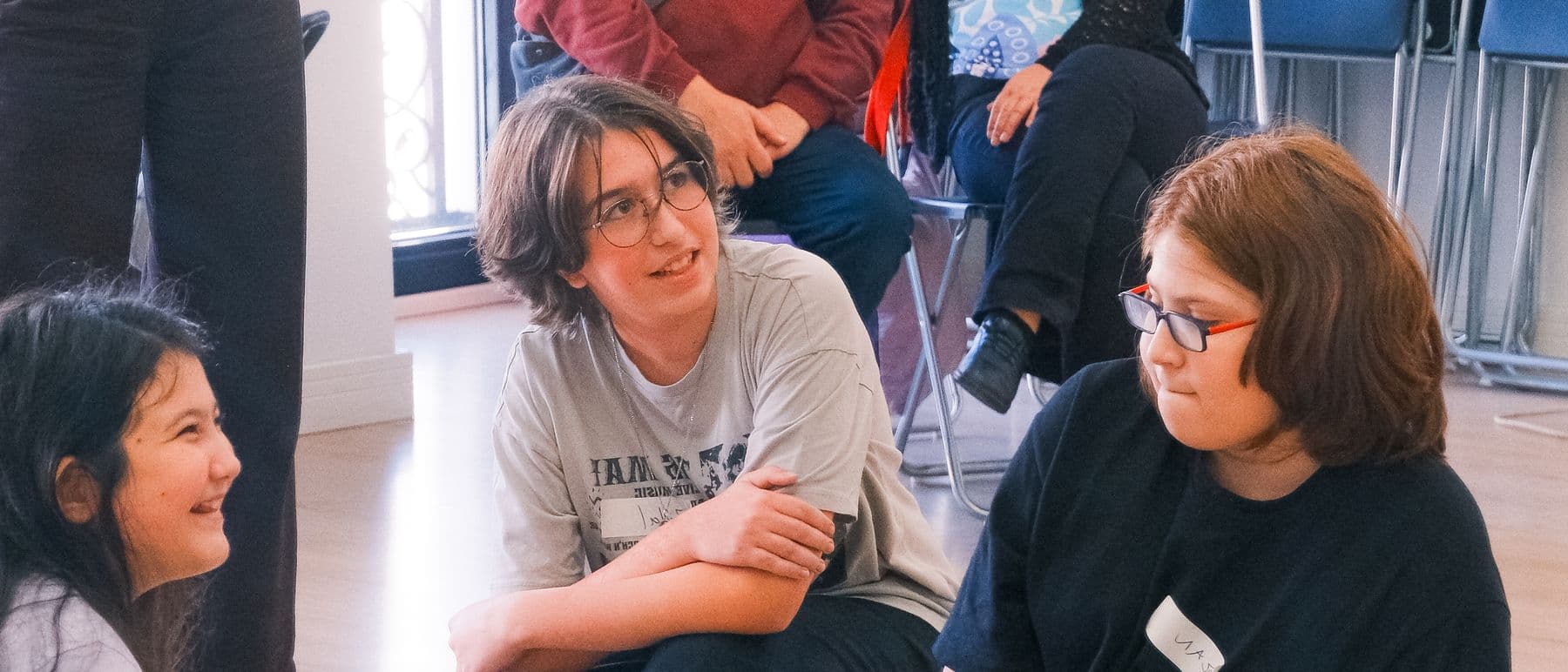
Creative Drama for Ages 8 to 17: A Parents' Guide for Istanbul
An eight-year-old and a seventeen-year-old do not need the same drama room. A guide to what creative drama looks like at each age band.
Parents often ask what age is right for drama. The more useful question is what drama looks like at each age, because the same word covers very different rooms. A child of eight and a teenager of seventeen need different things from a drama workshop, and a group that mixes them tends to serve neither. This guide walks through five age bands, from 8 to 17, and explains what changes. It is written for parents in Istanbul, many of them international residents or families with children in international schools.
Ages 8 and 9: full play
At this age children move easily between pretending and being. They are not yet watching themselves from outside, which makes drama feel natural: being an animal, an explorer, a character in a story. The work is about turn-taking, shared rules and building on a friend's idea. Nothing needs to be performed for anyone.
Ages 10 and 11: fairness and the group
Around ten, the group becomes the centre of attention. Who is paired with whom, what counts as fair, who laughs at what. Drama helps here because it lets children try the same scene from different roles and see a situation from the other side. Storytelling and simple scene-building begin.
Ages 12 and 13: becoming aware of being watched
Early secondary school is when many children start to see themselves from outside. A child who played freely at nine can suddenly freeze at twelve. Good drama work at this stage breaks visibility into small steps: first inside a crowd, then in pairs, then alone. Speed and silliness help; pressure does not.
Ages 14 and 15: identity and voice
Teenagers begin to ask what they think and who they want to be. Drama offers a safe route: speaking as someone else is an indirect way of finding your own voice. Improvisation and writing short scenes take a larger role.
Ages 16 and 17: craft and expression
By the end of school, drama becomes a craft: text, staging, argument, presentation, interview practice. Older teenagers can take critique and build scenes together.
Why we separate the age bands
A younger child cannot be protected from an older teenager's irony, and an older teenager feels small in a younger child's game. That is why groups are split by age. In Turkish, we have written a full set of guides, one for each age; start with the 8 to 17 creative drama guide (in Turkish) and see our drama classes for kids page.
What drama in English adds
Many families in Istanbul want the work to happen in English. This is where drama has a particular advantage: it gives children a reason to speak in the middle of a scene rather than a drill. Our parents' guide to English drama for kids and teens covers how this works, and why teenagers who pass English exams still freeze looks at the specific problem older students face.
What we run
English Drama Youth is our programme for ages 8 to 17, in Pera and Kadıköy. Groups are split by age, 8 to 12 and 13 to 17. It runs from October to May, one day a week, and the year closes with an English-language showing for an audience. We suggest B1 or above, and there is no placement test. For children just starting English there is a separate A1 to A2 route, open for pre-registration.
Related reading: What B1 English sounds like · English through drama for absolute beginners · Speaking anxiety in a second language
Get in touch
You can write to us in English. Use the contact page or email info@technelabistanbul.com, or WhatsApp 0552 242 59 71. You do not need to speak Turkish.
Frequently asked questions
What is the right age to start drama? There is no single right age. At each stage the work changes: play for the youngest, group and fairness in the middle, identity and craft for teenagers. What matters is finding a group that matches your child's age.
My child is shy. Will drama help? Often, yes. Drama makes mistakes normal and lets children try things without being judged. Pushing a shy child onto a stage rarely helps; small steps do.
Can younger and older children work in the same group? It is possible but usually harder. Younger children can be overshadowed and older ones can feel held back, so we separate the age bands.
Is the work available in English? Yes. English Drama Youth runs in English for ages 8 to 17, with groups split by age.
English Drama Lab runs weekly in Pera and Kadıköy, and there are free introduction sessions most weeks. Come once and see whether it is for you.
more in english
- English Improv in Istanbul for A2 and B1 SpeakersCan you do an English improv workshop if your English is A2 or B1? What the level asks of you, and where each group fits.
- Which English Theatre Workshop in Istanbul Fits Your Level?A1, A2 or B1: choosing an English-language theatre workshop in Istanbul by level, with what each group expects and where to start.
- What B1 English Sounds Like: Is Your Teen Ready for Drama?Parents hear 'B1 or above' and cannot picture it. Here is what B1 sounds like in a real conversation, and why there is no placement test.