Public Speaking in a Second Language: Why It's Harder
Why speaking in public in a language that isn't yours feels harder, what the research says about anxiety, and where rehearsal, improv and Toastmasters fit.
Public speaking in a second language is harder because two separate anxieties stack up: the ordinary fear of speaking in front of people, and foreign language anxiety, which research consistently links to lower performance. Both respond to practice, but not instantly. The most reliable route is repeated speaking in front of real listeners, with your opening prepared and the rest practised out loud, not memorised word for word.
This article is for people who present, pitch or speak up in meetings in English when English is not their first language. Many of them live in Istanbul, speak Turkish, Arabic, Persian, Russian or German at home, and have a perfectly good command of English on paper. Then they stand up and something changes.
Two anxieties, one microphone
The first anxiety is the familiar one. In a meta-analysis of 30 randomised controlled trials, Ebrahimi, Pallesen, Kenter and Nordgreen (2019, Frontiers in Psychology) describe the fear of public speaking as one of the most common fears in the general population, affecting up to a third of people. It is not a rare problem and it is not a character flaw.
You may have heard that people fear public speaking more than death. That line comes from a 1973 survey that never asked people to rank their fears. When Dwyer and Davidson (2012, Communication Research Reports) asked 815 students to tick fears on a list, public speaking was the one ticked most often. When they asked students to rank them, death came first. Public speaking is common and uncomfortable. It is not worse than dying, and you do not need to believe that to take it seriously.
The second anxiety belongs to the language. Teimouri, Goetze and Plonsky (2019, Studies in Second Language Acquisition) pooled data from more than 19,000 learners in 23 countries and found a moderate negative relationship between language anxiety and achievement (r = −.36). That is a correlation, not a verdict: anxiety may lower performance, weaker performance may raise anxiety, or both. What it does tell you is that the two travel together, and that a speaker who is anxious in English is likely to show less of what they actually know.
Put the two together and you get the experience many professionals describe: you know the material, you know the vocabulary, and on the day the words arrive half a second late.
Where the anxiety shows
A small study of business English students giving presentations (Ding, Chen & Xu, 2024, IRAL) found that anxiety was linked less to the content of their talks and more to delivery: use of voice, enthusiasm and eye contact. Their content scores were better than their delivery scores.
That matches what we see in rehearsal rooms. The slides are fine. The voice drops, the eyes go to the floor, and the speaker rushes to get it over with. That is useful to know, because delivery is trainable in a way that "confidence" is not.
Feeling like someone else in English
Many second-language speakers say they feel flatter, less funny or less themselves in English. Dewaele (2016, International Journal of Multilingualism) surveyed more than 1,000 multilinguals and found that feeling different when switching languages was not linked to how well or how long people had used the language. It was linked to anxiety about speaking it, for example with colleagues or on the phone.
So if you feel smaller in English on stage, it may not mean your English is weak. It may mean you are anxious in it. Those need different fixes.
What actually helps
The strongest evidence comes from psychological interventions. In the Ebrahimi meta-analysis, they reduced fear of public speaking clearly compared with control groups, and the effect was larger at follow-up. Most were cognitive or behavioural approaches. If your fear stops you working or living normally, that is the place to start, with a qualified professional. A theatre workshop is not therapy.
For everyone else, a few principles from the research are worth borrowing.
Do it yourself, not just watch. Bandura's self-efficacy theory (1977, Psychological Review) holds that the strongest source of belief that you can do something is having done it. Watching good speakers and being encouraged help, but less.
Vary the practice. A current model of exposure in anxiety research (Craske and colleagues, 2014, Behaviour Research and Therapy) suggests that what matters is learning that the feared outcome does not happen, and that variety and dropping "safety behaviours" (reading from notes, hiding behind a memorised script) strengthen that learning. This is a clinical framework. We borrow its logic, not its claims.
Prepare the opening, not every word. Memorising a whole talk in a second language is fragile: lose one sentence and the rest goes with it. A reasonable middle path is to prepare your first minute and your key transitions, then practise the rest out loud several times, in different words each time.
Where improv and rehearsal fit, honestly
Improvisation is often sold as a cure for presentation nerves. The research is more modest, and we think you should know that.
Casteleyn (2019, L1-Educational Studies in Language and Literature) tested an improv training focused on eye contact, voice and body language with secondary school students, using a control group. Their speaking performance improved, and the author describes the effect as significant but modest. In a second study (Casteleyn, 2019, Research in Drama Education), the same researcher found no direct short-term effect of improv on public speaking stress, while noting that benefits might appear over a longer period or for some participants more than others.
In language classrooms, Galante (2018, RELC Journal) found that foreign language anxiety dropped in both a drama-based programme and a regular English programme over four months, with a slightly larger drop in the drama group. Slightly, not dramatically.
Our reading: improv is not a switch that turns off nerves. It is a weekly practice of speaking without a script, in front of people, with a partner who changes what you expected. It works on exactly the delivery skills that anxiety disrupts in a second language, voice, eye contact, staying in the moment, and it does that over time rather than in one evening. We describe the format on our English improv in Istanbul page, and a wider map of what exists in the city in our guide to improv in English in Istanbul.
Toastmasters as a complement
If you want structured prepared speeches with feedback, Toastmasters is the established option, and Istanbul has several English-speaking clubs on both sides of the city. The format centres on prepared speeches, short impromptu answers called Table Topics, and evaluation from other members. It is a good complement to drama: Toastmasters trains the prepared talk and the feedback loop; a drama group trains the body, the voice, unscripted response and working with a partner. Plenty of people do both.
English Drama Lab
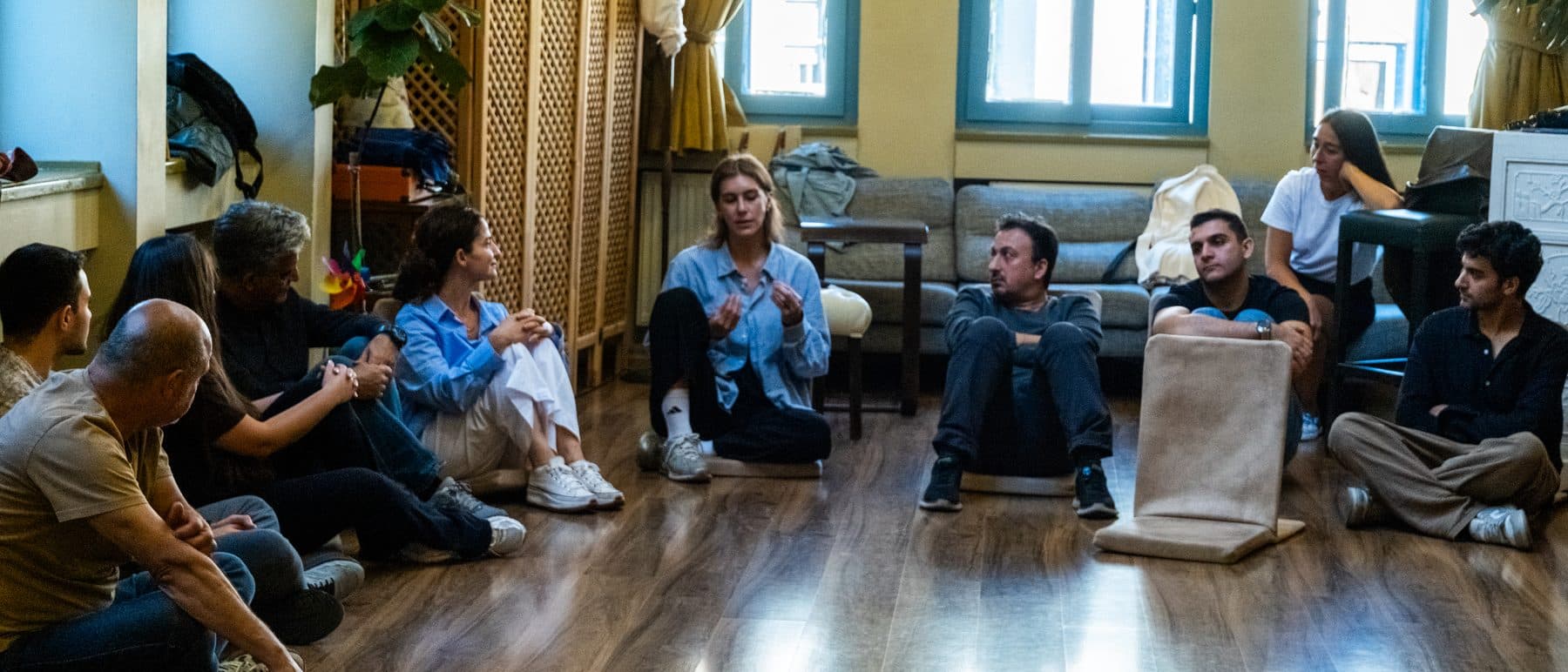
English Drama Lab is our weekly English-language workshop for adults whose English is around B1 or above. It runs in Pera on Saturdays at 15:00 and in Kadıköy on Mondays at 20:00, with a maximum of 12 people, and attendance is flexible, so you can join in any week. The facilitators are conservatoire graduates. There is no script to memorise: warm-ups, improvisation, status games and partner scenes, all in English. We do not promise to remove your nerves. We offer a room where you speak in front of people every week. See public speaking in English in Istanbul for how we approach presentations, or the English Drama Lab programme page.
If you are bringing a team, see our corporate programmes.
Related reading: Improv in English in Istanbul: what exists · Why teenagers freeze speaking English · English-speaking theatre in Istanbul
Frequently asked questions
Why is presenting in English harder than presenting in my own language? Because you carry two loads at once: the general fear of speaking in public and foreign language anxiety. A large meta-analysis links language anxiety with lower performance (Teimouri, Goetze & Plonsky, 2019), and in presentations it tends to show in voice and eye contact more than in content.
Should I memorise my presentation in English? Memorise the opening and your main transitions, not every sentence. A fully memorised talk breaks easily under pressure. Practise the rest out loud several times, phrasing it a little differently each time, so you can keep going when a word escapes you.
Does improv cure fear of public speaking? No. Studies show modest improvements in speaking performance and, in one study, no direct short-term effect on presentation stress (Casteleyn, 2019). Improv is a practice that builds over weeks. If fear seriously limits your life, psychological treatment has strong evidence and is the better first step.
Is Toastmasters or a drama workshop better for English public speaking? They train different things. Toastmasters focuses on prepared speeches and structured feedback; a drama workshop focuses on unscripted response, voice, body and partner work. Many people benefit from both.
Sources: Ebrahimi et al. 2019, Frontiers in Psychology · Dwyer & Davidson 2012, summary (KIOS) · Teimouri, Goetze & Plonsky 2019, SSLA · Ding, Chen & Xu 2024, IRAL · Dewaele 2016, International Journal of Multilingualism · Bandura 1977, Psychological Review · Craske et al. 2014, Behaviour Research and Therapy · Casteleyn 2019, L1-Educational Studies · Casteleyn 2019, Research in Drama Education · Galante 2018, RELC Journal · Istanbul Toastmasters · Istanbul Asia Toastmasters
English Drama Lab runs weekly in Pera and Kadıköy, and there are free introduction sessions most weeks. Come once and see whether it is for you.
more in english
- From A2 to B1 in English: Why It Takes LongerWhy the jump from A2 to B1 English takes longer than the first levels: Cambridge and Pearson hours, CEFR fluency descriptors, and what practice can do.
- Improv in English in Istanbul: What Exists in 2026A practical guide to English-language improv in Istanbul for expats and Turkish speakers: what exists, what improv does and doesn't do, and how to start.
- Starting English From Zero in Istanbul: An Honest GuideStarting English from zero in Istanbul as an adult? Realistic hours, the options in Kadıköy and Beyoğlu, and what to expect from your first 12 weeks.