From A2 to B1 in English: Why It Takes Longer
Why the jump from A2 to B1 English takes longer than the first levels: Cambridge and Pearson hours, CEFR fluency descriptors, and what practice can do.
Going from A2 to B1 in English takes longer than the earlier levels because the CEFR levels are not equal steps. Cambridge's guided learning hours put A2 at roughly 180–200 hours from zero and B1 at 350–400, so B1 needs about as much time again as everything you have done so far. The skill also changes: A2 is about short exchanges, B1 is about keeping going, and that comes from using the language, not only studying it.
If you passed A2 quickly and now feel stuck, you are not imagining it, and you are probably not doing anything wrong. This guide sets out the numbers, what actually changes between the two levels, what the research says about practice, and where a drama group fits.
The numbers
Cambridge English publishes cumulative guided learning hours for each level: about 90–100 for A1, 180–200 for A2, 350–400 for B1 and 500–600 for B2. Cambridge stresses that these are guidelines only. Previous language learning, intensity, age and practice outside class all change the figure.
Cambridge University Press (2018) gives illustrative examples based on a report by Christine Muir and Leigh Clark at the University of Nottingham. For an adult in favourable conditions, A2 to B1 takes 160–240 hours, or roughly 40–60 weeks at two hours of class plus two hours of homework a week. For a teenager in mixed conditions, 200–250 hours. The document is clear that these figures are illustrative and not empirically validated.
Pearson (Benigno, de Jong & Van Moere, 2017) estimates that moving from A2 to B1 on its Global Scale of English takes about 190 hours of active learning for a fast learner and about 616 for a slower one. The same paper states the principle plainly: CEFR levels are not equally wide, the step from A2 to B1 takes much longer than the step from A1 to A2, and progress is not linear. Plateaus and temporary setbacks are normal.
So when a programme promises A2 to B1 in three months, do the arithmetic. At four hours a week, three months is about 50 hours.
What actually changes between A2 and B1
The Council of Europe's descriptors for spoken fluency are worth reading in the original.
A2: "Can make him/herself understood in very short utterances, even though pauses, false starts and reformulation are very evident."
B1: "Can keep going comprehensibly, even though pausing for grammatical and lexical planning and repair is very evident, especially in longer stretches of free production."
For interaction, A2 "can answer questions and respond to simple statements" but "is rarely able to understand enough to keep conversation going of his/her own accord." B1 "can initiate, maintain and close simple face-to-face conversation on topics that are familiar or of personal interest."
Notice what does not change. Pauses are "very evident" at both levels. B1 is not the level where mistakes and hesitation disappear. The difference is continuity: from short, separate answers to keeping a conversation alive on your own, mistakes included.
That is why the step is hard. More vocabulary and grammar help, but keeping going is a skill you build by doing it, many times, under some pressure.
A note on the "intermediate plateau"
You will often read that learners hit an "intermediate plateau." In the teaching literature, that idea mostly describes the move from lower-intermediate to upper-intermediate, roughly B1 to B2. Jack C. Richards, for example, frames it explicitly as lower-intermediate to upper-intermediate. It is not good evidence about A2 to B1. The honest explanation for the A2 to B1 slowdown is the hours.
What practice can do: task repetition
One of the better-studied ways to build spoken fluency is task repetition: doing the same speaking task more than once.
- de Jong and Perfetti (2011, Language Learning) had high-intermediate adults give the same talk three times in shrinking time slots (the 4/3/2 technique). Only the group that repeated the same topic showed lasting gains, such as shorter pauses, and those gains carried over to new topics and held about four weeks later. The groups were very small, so treat this as a signal, not a law.
- Thai and Boers (2016, TESOL Quarterly) found that repeating a monologue under time pressure improved fluency but not complexity or accuracy. Students repeated their stories almost word for word, so the language did not grow.
- Zhang, Yi and Zhou (2023, Languages) found that both repetition groups beat a control group on speed and breakdown measures, and that interleaving tasks worked better than repeating one task in a block.
- A 2025 meta-analysis (Abdi Tabari, Zhuang & Farahanynia, System) found that task repetition mainly improves structure and accuracy, with smaller gains in fluency and vocabulary range. Effects were larger in foreign-language settings like Turkey, and shrank as the gap between repetitions grew.
Three practical lessons follow. Repeat, but change something each time: a new listener, a new obstacle, a new mood. Keep repetitions close together. And expect gains in control and structure more than instant fluency.
Exposure, instruction and use
A common idea is that you just need more exposure: watch series, listen, absorb. The evidence does not support exposure alone as superior. Meta-analyses have found explicit instruction generally more effective than implicit approaches (Norris & Ortega, 2000), or found only a small difference between them while confirming that instruction itself has a large effect (Kang, Sok & Han, 2019). Exposure helps, especially when it is active. In a Swedish study, out-of-school English correlated with teenagers' oral proficiency, and active activities such as gaming were more strongly linked than passive ones such as watching TV (Sundqvist, 2009). That study was correlational and small.
Our reading: a course teaches the language. Use makes it available when you need it. At A2, most people have plenty of the first and very little of the second.
Where a drama group fits
Drama is not pure exposure. It combines targeted phrases, obligatory output (you have to say the line in the scene), repetition through rehearsal, and a situation that gives the words meaning. It also matches the B1 descriptor closely: improvisation asks you to accept an offer, keep the scene going and close it. We see that as a conceptual overlap. No controlled study has yet shown that improvisation speeds up the A2 to B1 transition, and we will not claim it does.
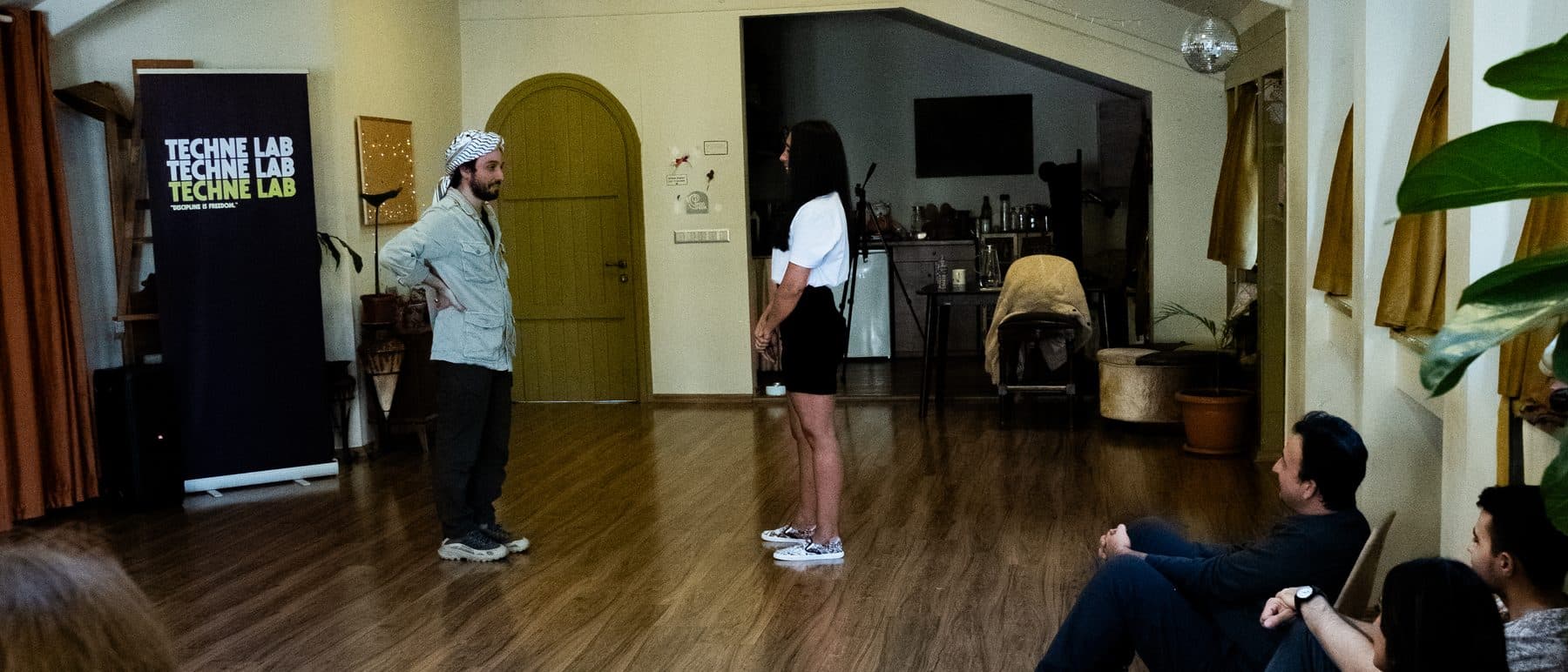
We are opening A1+ English Drama Lab for adults with little or basic English, including people at A2 who freeze when they try to speak. It runs for 12 weeks, 2 hours a week, in Pera and Kadıköy, with conservatoire-trained facilitators. Days and times are not set yet. Twenty-four hours is roughly 10–15% of the 160–240 hours Cambridge's adult example gives for A2 to B1, so we do not promise a level. We work on the part of the transition that usually goes missing: using what you know, with fewer pauses on the phrases you have practised, and more willingness to speak. Read more on beginner English drama in Istanbul or join the waiting list.
If you can already hold a simple conversation, our B1+ English Drama Lab runs every week; see also English improv in Istanbul.
Related reading: Starting English from zero in Istanbul · Why drama works for absolute beginners, and where it doesn't · Public speaking in a second language
Frequently asked questions
How long does it take to go from A2 to B1 in English? Cambridge's cumulative guidelines put A2 at about 180–200 hours from zero and B1 at 350–400, a gap of roughly 150–220 hours. Cambridge University Press gives 160–240 hours as an illustrative example for an adult in favourable conditions. Pearson estimates about 190 to 616 hours depending on the learner. All of these are guides, not guarantees.
Why do I feel stuck at A2? Because the step is longer than the ones before it, and because B1 asks for a different skill: keeping a conversation going on your own. Progress at this stage is less visible. Plateaus and small setbacks are normal, according to Pearson's research summary.
Can I reach B1 just by watching series and listening? Exposure helps, but research does not show it beats instruction. Meta-analyses find explicit instruction effective, and active use of English is more strongly linked to speaking ability than passive watching. Combine a course with regular speaking.
Is pre-intermediate A2 or B1? It depends on who uses the term. Schools use the label differently; at least one Istanbul language school lists its pre-intermediate course as B1, while others use the word for the level below. Ask for the CEFR level, not the label.
Sources: Cambridge English, Guided learning hours · Cambridge University Press 2018, How long does it take to learn a foreign language? · Benigno, de Jong & Van Moere 2017, Pearson GSE · Council of Europe, CEFR scales · Richards 2015, Cambridge blog · de Jong & Perfetti 2011, Language Learning · Thai & Boers 2016, TESOL Quarterly · Zhang, Yi & Zhou 2023, Languages · Abdi Tabari, Zhuang & Farahanynia 2025, System · Norris & Ortega 2001, Language Learning · Kang, Sok & Han 2019, Language Teaching Research · Sundqvist 2009, Karlstad University
English Drama Lab runs weekly in Pera and Kadıköy, and there are free introduction sessions most weeks. Come once and see whether it is for you.
more in english
- Improv in English in Istanbul: What Exists in 2026A practical guide to English-language improv in Istanbul for expats and Turkish speakers: what exists, what improv does and doesn't do, and how to start.
- Public Speaking in a Second Language: Why It's HarderWhy speaking in public in a language that isn't yours feels harder, what the research says about anxiety, and where rehearsal, improv and Toastmasters fit.
- Starting English From Zero in Istanbul: An Honest GuideStarting English from zero in Istanbul as an adult? Realistic hours, the options in Kadıköy and Beyoğlu, and what to expect from your first 12 weeks.